Ćakula Café — Slow Croatian Podcast | Learn Croatian With a Cultural Twist
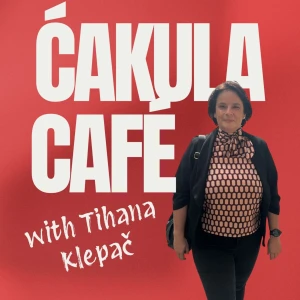
Ćakula Café is a slow Croatian podcast designed for heritage speakers and diaspora adults who understand Croatian but struggle to speak it. Hosted by Tihana Klepač, a Croatian language teacher and associate professor at the University of Zagreb, each episode uses slower, clearer Croatian at A2–B1 level. The podcast covers real topics and culture, avoiding tourist phrases and grammar drills. It aims to help listeners reconnect with their Croatian roots through accessible language learning.
Epizode
When Someone Dies and You're Far Away: A Funeral on a Small Screen | Ćakula Café slow Croatian podcast
The phone rings at three in the morning, and you know before you even answer. In Croatia the funeral will be in two or three days, and you're on the other side of the world.This episode of Ćakula Café talks about something rarely said out loud: the funeral watched through a phone a relative holds up at the cemetery, the days around the funeral that turn out to be what you miss most of all, and
At Home We Spoke English: The Decision Our Parents Had to Make | Ćakula Café slow Croatian podcast
People write in from Canada, Australia and America, and the same sentence comes up again and again: my parents spoke Croatian to each other, and English to me, and I don't know why.This episode of Ćakula Café answers that question. It goes back to the sixties and seventies, to a shop where people laughed when someone spoke with a foreign accent, and to a conversation with a teacher who gave parent
You're Not From Here or There: The Place Where You Stand | Ćakula Café slow Croatian podcast
In Croatia, they call you American, or Australian, or Švabo. Where you live, you are Croatian.This final episode in the series is about what it's like to stand between two countries and never be quite at home in either one, and why the sentence I'm not from here or from there doesn't have to mean something is missing.It also talks about one moment people remember for the rest of their
Paket: A Box That Crossed the Ocean | Ćakula Café slow Croatian podcast
A box stands at the post office. Brown paper, thick tape, the address written in capital letters. For many Croatian families, paket was the most important word of the year.This episode of Ćakula Café opens both boxes: the one that came from Germany, America and Australia, with coffee, sneakers and money tucked into a jacket pocket, and the one that went back, with rakija, pršut and a letter in whi
My Name Is Ivan, They Call Me John: The Name Left at the Border | Ćakula Café slow Croatian podcast
A twenty-two-year-old man stands in line with papers in his hand. The clerk asks his name. He says Ivan. The clerk writes John.This episode of Ćakula Café is about the names that were left at the border, about the letters č, ć, š, ž and đ that didn't exist on old typewriters, and about why so many people changed their own names simply because they were tired of explaining.And then about the gr
What Will People Say: The Most Powerful Sentence in a Croatian House | Ćakula Café slow Croatian podcast
A seven-year-old girl stands in front of the mirror, and her mother says the four words every Croatian child hears: what will people say. No one ever explains who these people are, but everyone knows they exist.This episode of Ćakula Café follows that question from a house painted only at the front, through the old word obraz, and small towns where a good name was once a matter of life, all the wa
Whose Are You: How Croatians Place You | Ćakula Café slow Croatian podcast
In a small Croatian town, a name is not enough. Someone looks at you, hears your surname, nods, and then asks the real question: and whose are you?This episode of Ćakula Café explains a system where houses have names older than surnames, where a person is not just a person but a continuation, and where a stranger turns into someone who belongs in three seconds.It also talks about a moment many in
Tri tjedna u kolovozu kada se selo napuni | Ćakula Café slow Croatian podcast
The car is packed to the roof, it's four in the morning, the street in Germany is empty. Two days later, in a village that has twenty people in February, there are three hundred.This episode of Ćakula Café follows the drive that generations of Croatian families make every August: the border, the warm air coming in through the window, the grandmother crying at the door, the relatives who call y
Ne moraš ništa donijeti: favourite Croatian lie | Ćakula Café slow Croatian podcast
The phone rings on a Tuesday evening. We're coming on Sunday, says the voice on the other end, but don't prepare anything. No one means it, and everyone still knows their lines by heart.This episode of Ćakula Café follows one Croatian visit from start to finish: from that sentence on the phone to the bag of pastries the hostess presses into your hands at the door. And it asks why food is never ref
Moraš biti duplo bolji — Why Croatians Use Sport to Prove They Exist | Ćakula Café slow Croatian podcast
There is a sentence millions of Croatian children heard at the kitchen table. In Canada. In America. In Australia. Their parents said it after long shifts, in a language they were still learning themselves.You have to be twice as good as them.This episode asks why. And discovers that the same feeling doesn't only live in diaspora families. It lives in Croatia itself. In a country of four milli
How to Use a Slow Croatian Podcast to Actually Learn Croatian | Ćakula Café A2
Was the last episode too hard? Good. That means it was working.This short episode teaches you exactly how to use Ćakula Café to improve your Croatian — even when the vocabulary feels difficult. How to use Spotify subtitles. Which words to look up and which to ignore. Why listening three, four, five times is not failure. It is the method.Croatian language teacher Tihana Klepač shares the same advic
Neopisivo: How Football Became the Croatian Word for Freedom — slow Croatian podcast
There are things that cannot be described — only felt. For many Croats in the diaspora, football was precisely that language: the one that says what ordinary conversations cannot. This episode of Ćakula Café starts from Maksimir in 1990, moves through the golden generation of 1998 and Šuker's six goals, to Modrić and half a million Zagrebians on the streets in 2018 — and ends with one word that sa
Brseč: Croatian vocabulary for old stone towns — slow Croatian podcast for intermediate learners
Brseč is a small Istrian town where time moves differently, where stone speaks and cats decide what matters. In this episode we walk through narrow lanes, past Glagolitic script on the walls, and arrive at the understanding that some smaller places — and some smaller parts of ourselves — need to be discovered slowly. Ćakula Café is a slow Croatian podcast for diaspora and heritage speakers at A2–B
Lepoglava: Croatian lace, language, and what we choose to keep — slow Croatian podcast
In a small Zagorje town, a Pauline monk spent his life writing the first Croatian encyclopaedic dictionary, and women in the same streets were making lace by hand — both acts of the same quiet conviction that some things must not be lost. This episode of Ćakula Café visits Lepoglava to explore what strpljenje — patience as a deliberate act, not passivity — actually looks like when it is passed fro
Sunce moje: Croatian grandparents and the words between us — slow Croatian podcast
My grandmother speaks only Croatian. I speak only English. We sit together and don't know what to say. This episode of Ćakula Café — slow Croatian podcast for diaspora and heritage learners at A2–B1 level — sits with that silence, and with the words that exist on either side of it. You'll hear the regional names for grandparents across Croatia, the diminutives that carry more love than any transla
Mirisna kuhinja: Croatian food vocabulary and memory — slow Croatian podcast for heritage speakers
Learn Croatian through smell — the sense that carries memory further than words. This episode of Ćakula Café, a slow Croatian podcast for A2–B1 heritage speakers and diaspora learners, takes you inside the Croatian kitchen: luk na ulju, češnjak, paprika, fresh bread from the pekara before the city wakes, lovor and ružmarin from a garden by the sea. Many diaspora listeners describe smelling Croatia
Tržnica: Croatian market vocabulary — slow Croatian podcast for heritage speakers | A2 B1
Learn Croatian with this slow Croatian podcast episode for intermediate learners at A2 and B1 level. If you are a heritage speaker, diaspora learner, or anyone reconnecting with the Croatian language and culture, this episode takes you inside the Croatian tržnica — the weekly market. From Zagreb's Dolac to Split's Pazar, we explore essential Croatian vocabulary: svježe, kilogram, koliko košta, pro
Sunce i more: Croatian summer vocabulary — slow Croatian podcast
Learn Croatian through the sounds and rhythms of a Croatian summer. This episode of Ćakula Café — a slow Croatian podcast for A2–B1 heritage speakers and diaspora learners — takes you to the Adriatic coast. In slow, clear Croatian we explore the words that carry a whole season: kupanje, bura, fjaka, sunce, plaža. No grammar drills. Just the language, the stone beaches, and the smell of salt in the
Nedjelja: Croatian family traditions and the vocabulary of home — slow Croatian podcast
Sunday in a Croatian home is not just a day of the week. It is a ritual — the smell of roasting chicken or stuffed peppers, a table set for the whole family, a father who always knew how to make everyone laugh too loudly for a small apartment.This episode for A2 Croatian learners moves slowly through one Croatian Sunday — the food, the table, the conversation, and the particular unhurried feeling
Stjepan Miletić: Croatian theatre history and the making of HNK Zagreb — slow Croatian podcast
There is a name every student of Croatian theatre history must know. Stjepan Miletić — intendant, director, writer, reformer. A man who, in just four seasons between 1894 and 1898, transformed the Croatian National Theatre from a struggling institution into one of the leading theatre houses in Europe.This episode for A2–B1 Croatian learners moves slowly through Miletić's life and legacy — the refo
You don't just go to the shops. You plan a whole birthday. - slow Croatian podcast
My son has a birthday. Friends are coming. And somewhere between the tomatoes and the olive oil — which I remember only at the very end, at the far corner of the supermarket, naturally — there is a meal to plan.This episode for A2–B1 Croatian learners comes to the supermarket. You will hear me think out loud through the aisles: bruschette, stuffed peppers with tuna, little chicken bites, olives, a
Walking Opatija — On Easter, Memory, and a City That Made Me — slow Croatian podcast
There is a church in Opatija that I have been walking into since I was a little girl. Every Easter morning, before breakfast, before anything. My mother carried a basket — eggs, ham, spring onions — and we waited for the priest to bless the food. That was the rhythm of Easter. That was the rhythm of home.In this episode I take you on a walk through Opatija — the city where I grew up, the city that
Who Tells the Story? — On Croatian, History, and Coming Home — slow Croatian podcast
I spent a day holding an old photograph. Black and white. My grandmother, standing in a studio, in her best dress. A village woman. She spoke Croatian because it was hers — not the language of law or school or government, but the language of home, of prayer, of love.For almost nine hundred years, Croatian was not the official language of Croatia. Latin, German, Hungarian, Italian — those were the
Volim te, sunce moje — On Living Between Croatian and English — slow Croatian podcast
There is a particular kind of tiredness that comes from living in two languages. Not the tiredness of translation — that is something else — but the subtler exhaustion of never being entirely in one place. Of laughing a second too late at a joke in English. Of reaching for a Croatian word in front of your children and finding it slightly out of reach. Of code-switching so automatically that you st
You Don't Just Attend a Croatian Wedding. You Survive It. — slow Croatian podcast
A Croatian vjenčanje is not an event. It is an endurance. It begins with zaruke — the engagement, the promise, the first round of tears — and it does not end until the kolo has gone around enough times that everyone has forgotten what time it is and nobody quite cares.This episode for A2–B1 Croatian learners moves slowly through one of the richest cultural occasions in Croatian life. You will hear
Izgubljeni u gradu: Croatian directions and city vocabulary — slow Croatian podcast
Every Croatian city has a moment that tests you. You know roughly where you are going, you have the address somewhere on your phone, and then someone asks if you need help — and suddenly the language you have been quietly building deserts you entirely.This episode for A1–A2 Croatian learners walks slowly through a Croatian city, one turn at a time. A mother and son looking for the ljekarna — the p
Ima vremena: Croatian vocabulary for waiting, fear, and beginning — slow Croatian podcast
Ima vremena. There is time. It is one of the most Croatian things you can say — an exhale, a hand on the shoulder, a small insistence that urgency is not the only way to move through the world. And yet, for many of us, there comes a moment when ima vremena stops being reassurance and becomes something closer to a hiding place.This episode for A2–B1 Croatian learners sits honestly with that moment
Ljubav bez riječi: Croatian family vocabulary and immigrant experience — slow Croatian podcast
Many Croatian parents never said volim te. Not because they didn't feel it — but because love, in their generation, was not a sentence. It was a practice. It was the shift they worked, the meal they made, the fear they carried quietly so their children wouldn't have to carry it too. It was endurance as its own kind of tenderness.This episode for A2–B1 heritage speakers and diaspora learners moves
Susjedi: Croatian neighbour conversations and everyday phrases — slow Croatian podcast
In Croatia, the fence between two gardens is rarely just a fence. It is where news travels. Where opinions form. Where someone asks to borrow something and stays for forty minutes. The neighbour — susjed or susjeda — is a particular figure in Croatian life: not quite family, not quite a stranger, occupying a category of relationship that English does not have a precise word for.This episode for A2
Kava: Croatian café culture and everyday conversation — slow Croatian podcast
In Croatia, you do not simply go for coffee. You go for kava — and that is an entirely different thing. Kava is not a drink you finish quickly at a counter on your way somewhere else. It is the reason you stop. It is the table you return to. It is the hour — sometimes two — that Croatians protect in the middle of the day as if it were something sacred, which in a quiet way it is.This episode for A
Zašto šutimo: Croatian vocabulary for fear, speaking, and finding your voice — slow Croatian podcast
There is a silence that falls over people who know more Croatian than they let on. They follow the conversation. They understand the joke. They know, roughly, what they want to say. And then someone turns to them — a ti, kako si? — and something closes. The words that were there a moment ago are suddenly nowhere.This episode for A2–B1 heritage speakers and diaspora learners sits with that silence
When you understand but can’t speak
There is a stage in learning any language that nobody warns you about properly. You understand almost everything. You follow the conversation, you catch the jokes, you know what you want to say. And yet when you open your mouth, what comes out is not quite what was in your head. Or nothing comes out at all.This episode for A2–B1 Croatian learners sits with that experience — not as a problem to sol