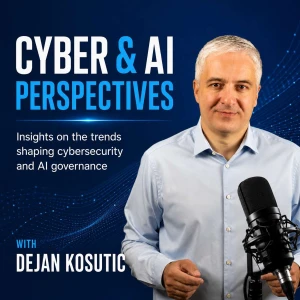
Cyber & AI Perspectives — Insights on Cybersecurity and AI Governance
Cyber & AI Perspectives is a podcast aimed at cybersecurity and AI governance professionals. Host Dejan Kosutic, an expert in these fields, covers key trends, risks, and strategic developments affecting organizations. Each episode offers independent analysis and insights to help listeners understand current and future challenges. The show also invites feedback and topic suggestions via podcast@advisera.com.
Epizode
Prioritize Your AI Risks: The AI Risk Portfolio Matrix
See the video here: The AI Risk Portfolio Matrix https://www.youtube.com/watch?v=gH8jFGPOrPsDejan Kosutic explains how organizations can quickly identify which AI systems need attention first by using an AI Risk Portfolio Matrix based on three factors: Criticality (how serious consequences could be for people, processes, and data), Reach (how much of the organization or external world is
Stop Preparing Evidence for Your ISO 27001 Audit
If you’re preparing for ISO 27001 certification, shift your focus from asking “How do we prepare the evidence?” to “Are our security processes actually working?” When risks are properly assessed, controls are appropriate, people know their responsibilities, and controls are consistently performed and monitored, the evidence will largely already exist. Build and strengthen the security pro
Cybersecurity is More Than AI: 3 Trends You Shouldn’t Ignore
Dejan Kosutic argues that a major cybersecurity mistake today is focusing so much on AI that companies overlook other critical trends. He highlights three non-AI areas that need attention: quantum computing and post-quantum cryptography, emphasizing the “harvest now, decrypt later” threat and why PQC matters now; supply chain security, noting that breaches often occur through vendors and
Who Will Win the Software Vulnerability Race? Five Scenarios
Dejan Kosutic explains how increasingly powerful AI models will be accessible to both attackers and defenders, accelerating the software vulnerability race. He outlines five scenarios: permanent defender advantage, permanent attacker advantage, a two-tier world where well-resourced organizations improve while SMEs and under-resourced sectors become prime targets, a “catch-up” period where
Security vs. Compliance: Are We Asking the Wrong Question?
Dejan Kosutic discusses whether security or compliance is more important and argues that this is the wrong question. He explains how compliance can support security through three “Bs”: acting as a booster by unlocking budgets when regulations or client requirements make security obligatory; providing a baseline via standards like ISO 27001 and technical security standards; and enabling a
The Missing Half of Cybersecurity: Security Management
Dejan Kosutic explains a common bias in cybersecurity: focusing on implementing controls but not managing them. Using backups as an example, he outlines why effective security requires planning (e.g., setting objectives like RPO and backup frequency), monitoring to ensure controls work in production, internal audits to verify tasks are performed, continual improvement to prevent recurring
The Dangerous Illusion of Cyber Readiness | Cyber & AI Perspectives
Dejan Kosutic explains that while many companies believe they are prepared for disruptive incidents, their continuity and recovery plans alone are often insufficient. He argues that plans cannot replace missing resources such as redundant systems, properly secured backups, or replacement staff, and that unclear recovery time and data loss tolerances lead to misaligned preparations. He als
Lessons From the C-I-A Triad to Build Trustworthy AI | Cyber & AI Perspectives
Dejan Kosutic explains how cybersecurity’s CIA Triad—confidentiality, integrity, and availability—has guided risk identification, prioritization, and control selection for decades, and argues that AI governance needs a similarly clear guiding principle: trustworthiness. Citing the OECD AI Principles, the EU AI Act, and the NIST AI Risk Management Framework, he describes trustworthiness as
How Apple Uses Cybersecurity as a Competitive Advantage
Dejan Kosutic explains how cybersecurity can create a real competitive advantage and uses Apple as a key example. He notes many companies pursue ISO 27001 and similar certifications mainly for sales and market access, but questions whether certificates provide a lasting advantage since competitors can obtain them with relatively little time and money. He defines competitive advantage as h